Showing posts with label wonder. Show all posts

Thursday, September 15, 2022

It begins with a bang and ends with a hum

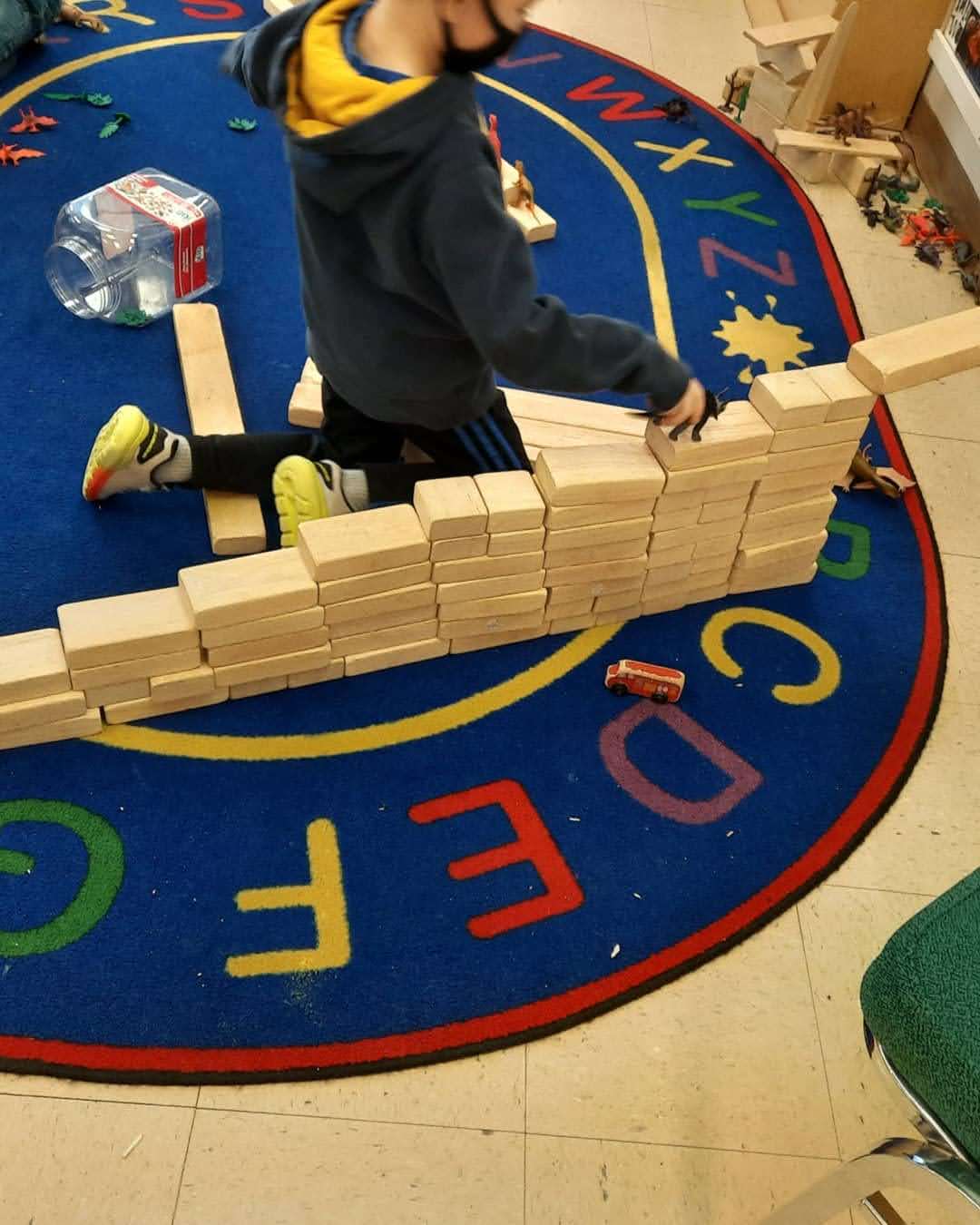
Play time in Kindergarten is so complex. In some ways it's straightforward, and others it's an intricate dance between fellow humans learning to navigate in the world. What I have always noticed: It always starts loud. Children jockeying for attention, for position, for a place at the table of play. But after awhile, it settles and shifts. The volume goes down so subtly that you may not even notice it until, suddenly, you realize you can hear your own thoughts again. 

Children come to school from so many varied backgrounds. Some of those backgrounds fit neatly into preconceived notions about what childhood should be. Others would break your heart. But at the center of all of them is the Child. And a child is built to play. Play is how we break it all apart and put it all back together. 

Every child brings their life experience to the play. The good, the bad, the in between- they all have a place in our play. If you are quiet, observant, able to step back, you will hear the story, see the dance. It takes discipline to not rush in to change it, to quiet it, to take it over. It takes trust to let them lead. However, when we do, we begin to see their spirits shine through. The insecurities melt away when children are allowed to master a skill through play. They begin to see themselves as capable, as independent, as someone who can lead. 

They learn to share space with each other, which, in turn, teaches them that there are other perspectives in the world, not just their own. When we allow the play to evolve independently from the bang to a hum, we know that's where the good stuff happens. That's where the noise of play turns into the music of community.

So let them play, let them be loud. Because, and trust me on this, naturally they will soften and quiet. Their will turn the noise into music, the bang into a hum.


Monday, June 7, 2021

Don't worry, about a thing.


I have a confession. I was not a very good guided reading teacher this year. Between students being pulled out at various times throughout the day, to a schedule that was rarely the same from one day to the next (we have a 6 day cycle, and my music and physical ed classes were sporadically mixed), guided reading was often forced to take a back seat. 

But you know what? When I did my reading records for the year, each and every student that was assessed was meeting or exceeding grade level expectations. And when I looked critically at their writing, same thing. And math? Yep. Meeting or exceeding grade level expectations.

So, what does this tell me? Nothing new, but certainly reinforces what I have been saying, and believing for years. It isn't so much what we teach in Kindergarten that matters, it's how we set the stage for our students to learn. We need to trust the process. Sometimes I think that's the hardest part about teaching 4, 5, and 6 year olds. We have so much information being thrown at us from so many different directions, we forget to listen to that small voice in our heads that says, "It's going to be alright!"

In my class we sing. A lot. And one song we sing is Bob Marley's Everything Is Gonna Be Alright. That's been my theme song this year. Between Covid lockdowns and isolations, to my father's passing, to just... teaching and life. I often needed to remind myself that everything *will* be alright. 

So, that's my message to youuuu 🎶- 
Don't worry, about a thing. 'Cause every little thing, is gonna be alright...

Trust your students. Trust their process. Trust their timing. Trust their intellect. Trust their learning. They will get it. They will excel. We just have to step back and let those birdies fly!

This is what trusting their process looks like in my classroom:

This guy came into my classroom in the third term. All of his play was very contained, and everything had an academic outcome. He really had a learning curve when it came to creativity, but it was only about a month before he stepped out of his "box" and started to play with others. And now, here he is, fixing my sink. 

The girls play with the blocks in a different way than the boys do this year. We had a day where we were able to bring our stuffies for a Teddy Bear Clinic. We then were able to play with them in the classroom. Here, the girls built homes for them, with layouts that included rooms, kitchens, bathrooms, etc. Each stuffy had the best home!


We have recently discovered the joy of building puzzles together. This puzzle is of children from around the world. What this group seems to enjoy, more than others, is building a puzzle together and them acting out the picture. Here we are dancing around the puzzle. So much joy and creativity flows when we give our children the time and space to do things.

We always love a good 3D shape unit. Here, one of my students made their own 3D shapes with play dough. There was a time when I would have had the whole class do this together. There was a time when I would have spent so much time talking about 3D shapes. This year, I let them tell me what they knew, and demonstrate their own learning in their own way. My lesson learned? Don't waste their time with nonsense. They have too much to do, they don't need to listen to me, just so I can feel like I have been a "real teacher" That's not what they need. What they need is to build, create, and explore. Just like this one did with the play dough, and just like the ones below did with the blocks:

\


Reading and writing are always such a huge portion of our afternoon. I do believe direct instruction does have a place in Kindergarten, don't get me wrong! But I also believe that they are perfectly capable of demonstrating their learning and their knowledge in a way that best represents who they are. We had some pussy willow branches that grew and the leaves began to bud. This prompted one of my students to name the plant Jake, and then he labeled the jar. I love that they are given the independence to do this!


Giving students a chance to build, design, draw, tell their story, all before encouraging them to write it down also sparks a new way of thinking for them. I have seen some amazing stories, both fiction and non-fiction come out of this group. Not because they are naturally gifted in this area, but because they have been given so many opportunities to tell a story before they have had to worry about committing it to paper. Here, one of my students was telling the story of her day, and she included "I am building" into it.


If your are getting to the end of the year and are afraid they might not be ready to move on, "don't worry, about a thing. Every little thing, is gonna be alright". Step back and watch what they can do. I am so glad I have been able to give them this time to grow, to learn, and to work together in community! I always reflect back to my masters in 21st century learning. It's a new age we are living in. Our students are going to grow into a world we haven't even seen yet. But we know what skills will be necessary to live in that world:
Critical Thinking, Communication, Collaboration, and Creativity. 
When we allow our students to learn through play, we are not only preparing them for the next grade, we are preparing them for life.


Sunday, February 14, 2021

A Playlist for Kindness

Kindness doesn't care how old you are, what your skin color is, who you voted for, or anything else. Kindness just matters. 


I saw on Facebook, that this week, February 14-20,  is "Random Acts of Kindness Week".  I've been thinking about kindness lately. I know I am feeling much more sensitive these days, and I am trying to lean into that. Everywhere I look I have seen moments of extreme kindness, and moments of true meanness. Humanity is such a complex concept. We have the ability to be brought to tears of empathy by someone in need, and yet still spit on another's shortcomings. Sometimes it depends on the time of day which response we will choose.

On Friday I made a pretty innocuous reply to a tweet by Dr. Biden on Twitter. She (or her pr people, I don't really care) posted pictures of huge heart cut-outs on the White House lawn. It was such a teacher-y thing to do, and it really made my day. I said I was happy there was an educator in the White House and thanked her for what she does. Pretty bland, but the responses I got! Not so bland, lol! It's a lot easier to be mean these days, have you noticed? According to those Tweets, I am, "what's wrong with education today", "brainwashing children to hate themselves", "blind to propaganda" "narcissistic indoctrinator", and the list goes on. Whatever- I choose to not reply, and I choose to not let nameless (because most of them don't even use their real names), faceless dots on a screen hurt me.

Every year in my kindergarten class, we spend a lot of time talking about kindness. We sing about it, we read about it, I try to infuse it into so many of the lessons we have during the day. Kindness is more than just being nice, it's thinking about another person in such a way, and treating them in such a way that you would want to be treated. Kindness is finding ways to make someone happy, to make their load easier, to help one another. The more we infuse kindness into our day, the more I see it being played out in their lives. 

One year I had a student who was very petite. While she was at recess one day, an older student started to make fun of her size, which caused her to start crying. When her classmates found this out, they were outraged. Now, let me give you a bit of a background on this class- they literally (I do mean to use that word literally) fist fought over every single thing. It was a most exhausting year. But, as much as this class fought each other, they could not stand by and let one of their own be made fun of. From that day on, my friend never was left alone on the playground again. There was always someone close by. They clearly picked up on some forms of kindness...

This year, one of my students struggles to get her boots off. Her friends take turns volunteering to help her. 

Last year my students would teach their classmates how to do intricate art activities.

One year I had a student with loads of emotional and behavioural issues. After he tore the classroom apart for the umpteenth time, I wanted to talk about it with the other students. They proceeded to tell me all of the wonderful things this one student would do.

Children understand kindness, and they practice it. They aren't perfect, and they still have those "me first" moments, but when you take time to build a classroom community, things like this happen.

What does it mean to be a human? What does it mean to do kind things? You don't always have to like the other person, you don't even have to know them. But you can always be kind to them. If you can be anything, be kind. Always.


Kindness playlist:

Monday, February 8, 2021

Dinosaurs! Self-Regulation Part 3

This post is the third in a series around self-regulation. I started off by talking about the importance of long, uninterrupted play time in kindergarten that gets our minds and our bodies ready to sit and listen (for a developmentally appropriate amount of time, btw). Then I wrote on how the environment we create as adults (calm, serene, low-stress) adds to the way our students can self-regulate. Now I want to speak on a specific type of play- dramatic play. In this post I will be focusing on dinosaurs, because that's where we are in my class. 

My observation is around dinosaurs and the type of play that is involved when we pretend we are large, carnivorous creatures. I hesitate to say "violent" because I don't think that's the attitude I want to cultivate in reading this. Perhaps aggressive is a better word; aggressive in a controlled way. I have a particular student (although he is not alone) whose first instinct when upset is to lash out and hit. All through September-December we worked on this, looking for ways we could react that didn't involve hurting others, and it was getting better. But, then we had two weeks off, and some behaviours returned. 

Before our winter break I noticed that some of us were interested in dinosaurs, so over the holidays I went out and bought some toy dinosaurs and set them out, along with some books I have. I didn't want to dictate what we would do with them, I didn't want a "unit" or a "study", I just wanted to give them another dimension of dramatic play. What I noticed was this: the more we interacted with each other as dinosaurs, both carnivores and herbivores, the less our aggression came through in other aspects of the day. Giving my students a place to put that type of aggression helps them self-regulate their own feelings of powerlessness (because I believe that's why we start off by hitting in the first place- we feel powerless in a situation and the only thing we can do is lash out). It allows them to feel that power, it allows them to "fight it out" in a safe environment. The more they have been able to use these dinosaurs, the less aggressive their play has become as a whole, and the more complex their play has become- from sorting and stacking, to building structures for the dinosaurs to climb on. And the aggressive behaviour outside of this play also continues to decline. 

Does this demonstrate the power of play in our lives? It most certainly does! Play isn't just a break, it isn't something an adult can manipulate in order to get an outcome they want. Play is what a human mammal needs to make sense of the world around them. Play is what we need to develop certain neural pathways in our brains. It is through play that we put into reality what our brain knows. As the teacher I have certain responsibilities to my students and their parents, but I can't make them learn. I believe it is my job to set up the environment in such a way that through their play they are able to master the skills they will need in life. Every day my students amaze me with what they can do. It is never easy to quantify this, to use it for comments on a report card- but it is always exactly what they need in order to be where they are and move forward. 

This is the stuff that makes teaching kindergarten so important. This is the stuff that matters. 


Sunday, January 31, 2021

All is calm. All is bright. Hygge in the classroom. Self-Regulation part 2


Authors Note: Last week I wrote about play and self-regulation. It seems I have a bit of a theme these days, because, in a sense, this week's post is also about self-regulation, and as I think about next weeks post... same thing! So, if you'd like to read last week's post, you can find it here: Play and Self-Regulation Now, on to this week:


In the course of a school year, particularly if you live in a northern climate, the months of January, February, and March drag on. Three months, but they can sometimes seem like the longest three months of the year. It's cold outside and the weather can be dreary and unpredictable. Every winter has its own pattern. This winter, our weather pattern seems to be: snow, rain, freeze, ice, snow, rain, freeze, ice, repeat. 

In order to combat this type of seasonal unbalance, we try to make our inside calm. In our homes, this might manifest in comfy blankets and spaces, candle light, warm drinks, quiet music and sounds. We can do this in the classroom too. Embracing the Hygge way in the classroom leads to a sense of well-being for all, and another way to promote self-regulation in Kindergarten.


Because of Covid, our school has a "staggered entry"- which means, as the children get to school they come straight into the classroom. Other years they played on the playground until the school day began. This created students rushing to get into the school, pushing, shoving, chaos. When this year began, and we discussed this "new" idea, my concern was, what to do with them? I started out having play time. As soon as they came in, they would sign in (a way to practice writing their names), then they would go play- with the over-head fluorescent lights blazing away. As winter approached, this method wasn't really working for anyone- it was loud, it was hectic, and it was overwhelming for many. I thought about this and decided to switched our schedule around a bit- come in, sign in, and sit at the tables doing quiet activities like play dough, drawing, writing, reading, until everyone gets here, then do a morning meeting before our play time. 

Now when the children come in, the lights are dimmed. I have a plethora of Christmas/fairy lights, as well as some stand up lamps around the room to give it a soft, warm glow. I play environmental music, or some kind of calming "happy" music. The children can talk, of course, they can move around and visit each other (masks on), it isn't an "everyone sit down and be quiet" time. It's just a calm, quiet way to centre ourselves before we start our day. So many of us ride the bus- which can be so hectic and crazy, then they come into a hallway where kids may be running up and down, yelling, etc (we are a hallway of 6 classrooms of 5 and 6 year olds after all)- that it helps to have this little down time to acclimate to being back in the classroom.

After we all arrive, we have a morning meeting. We sing songs, talk about the day, incorporate a little math workshop, then move into our play time. I keep the lights low for play time, as well, and I play the calming music in the background. We try to keep the atmosphere as cozy as possible. Sometimes I'll even put up a fireplace video or a video of a stream in winter, etc. on the board.

Does all of this work? It does. In the Reggio Emilia approach to learning, we often say "environment is the third teacher". This is a perfect example of that- if the environment is calm, it creates a general feeling of calm. And calmness allows us time to think, plan, create, problem solve, talk, and discuss. What I have found is even those days when we are a bit more...extra... than others, we still have room to breath. This idea of Hygge- creating a calming, cozy atmosphere- is possible in the Kindergarten classroom. 

There are many things that Covid has taught us as educators. We were not trained to teach in a pandemic, we were not trained to teach students to wear masks and social distance as much as possible. But there have been some benefits of Covid- I call them my Covid Linings. Embracing a Hygge classroom is just one of those Covid Linings. I've toyed with it, I've experimented with it in the past, but this year has given me permission to just go with it. I think this will be the way from here on out.


Next Week: Self-Regulation part 3: Dinosaurs!


This website really helped me define what I mean by Hygge: Hygge House


Saturday, April 12, 2014

I REALLY like science.

Last post was a bit of a downer. It certainly wasn't a good week that week, but I am glad to say that the next week made up for it. It seems like, as a class, we have all come so far- almost overnight! One more reason to love kindergarten. One week you are at the bottom of the garbage can emotionally, and the next week BOOM! you are noticing all of the wonderful things that are going on all around you.

This past Thursday, I was privileged to be a part of a group of like-minded educators concerned with environmental education in our classrooms. The educators in this group ranged from early childhood all the way through university. There were ECE's, kindergarten teachers, student teachers, high school teachers, alternative education teachers, and a university professor. We ran the gamut for education, and it was exciting to be there.
At the beginning of the meeting we were asked to bring in one "environmental artifact". As I thought about this, I realized how important science is to me in my classroom. I probably put more effort into my science area than many other areas. I truly enjoy the look of concentration on the students faces when they are working and investigating in the science area. I love the feeling of accomplishment they have when they are able to create designs in the sandbox just like an Andy Goldsworthy. I also love that much of our literacy outcomes can be met through science, technology, 'engineering', math, art (STEM, or STEAM)- because, you know, all that matters is literacy, right? (she says sarcastically...)

I wanted to share a few pictures with you, I hope you enjoy!


It's not a huge area, and you can't see it, but the block area is right next to the science centre, and art is adjacent as well. My goal was to have it all seemlessly flow into each other (except the art shelf goes up against the sand box).  
I want the science area to be one of personal and individual discovery. It is small, because I want it to be intimate. Too many people and we tend to lose the discovery feeling.
Because we live on an island, I wanted my sandbox to reflect our local beaches, so I have added sand from the beach, driftwood, local sandstone, shells, starfish, etc. to the area. I wanted them to be able to create in the classroom what they could create on the beach. I put up pictures from Andy Goldsworthy, some Stonehenge pictures as inspiration, as well as some pictures of their own creations. 

I am looking forward to the rest of the year as we will be moving into an Earth day/Environment/Farm (because not only do we live on an island, but farming is a large part of our economy) investigation. 
Did I say I really like science?

Tuesday, November 12, 2013

Ramps: To intervene or not? That is *always* the question!

In my classroom, one of the ways I try to engage our young learners is through investigation. I like to discover (through observation) a topic that the students are interested in, find ways to build learning around it, and help scaffold their learning. The key though, is to realize when the students need you to help scaffold their learning, and when they are able to do it themselves.

From the beginning of the school year, many of us have been fascinated by ramps and building ramps. At first, I thought that would make a wonderful project for us. However, as I continued to observe, I realized there really wasn’t anything else I could add to the discovery. The children, on a daily basis, have helped each other build their knowledge of ramps, and what ramps can do. As I spoke with the children, I learned that the children already knew a lot about ramps. They had already figured out which ramps made the cars go farther, faster, and how to build one with the proper incline for what they needed.

At first, our ramps started out being built from the floor.

We enjoyed pushing the cars over the ramps and bridges.

As time went on, the floor ramps became steeper, allowing for more force behind our vehicles.


Sometime, around a month ago, we discovered that if we lean the block against the bookshelf, we have a steeper ramp, which makes the cars go farther and faster.


Now, we have begun adding extra ramps, so the cars go fast AND jump.


The more we work on this, the more complex our ramps are becoming.
Through all of this, the students are learning not only about force and motion and gravity, but about problem solving. About team work. About trial and error. These are what we call "21 Century Skills." These are the skills we will need as we grow and mature, not only for school, but for life. 

So, I continue to reflect. Do I need to add myself into their "conversation"? Or is what I add only going to diminish the work already done. As I observe I notice that it is true what they say about learning: your peers really do teach and encourage you to learn more than your instructor does. So, for now,  I'll watch to see what I can learn. I will allow them to teach each other -and me.

Thursday, March 22, 2012

Wonder

  1. Have you ever watched a movie that so impacted you that you were compelled to watch it? One that the more you watched it, the more excited you became so that by the end of it you knew you must watch it again, you must own it? Maybe you even began to note certain lines because it was so important to you? The film,Mr. Magorian’s Wonder Emporium was just that film for me. From the very first line I was hooked.

    At the very beginning of the film, the character Eric is narrating and he says something that is so profound that it made me not only sit up and listen, but I made my children back up the DVD so I could write it down: “I don’t know why grown-ups don’t believe what they did when they were kids. Aren’t they supposed to be smarter?”

    That one line set the tone for the rest of the movie and kept me literally so enthralled I could not take my eyes and ears off the screen. That one line personifies what it means to have child-like faith. To believe because that is just what you do, because there is no other option.

    For one year I was a youth group sponsor. That year taught me many things, but most importantly it taught me that I am not a good youth group sponsor. My problem is that I think teenagers should be more responsible than 5 year olds, because they are older and supposedly more mature.

    I also learned that it is almost too late to build a spiritual foundation if we wait until our children are teenagers (and I say almost only because someone out there will tell me of their own conversion in teenage years, even though I would probably guess they had some spiritual foundation as a young child). By the time we are teenagers, we have been too jaded by the world. By the time we are teenagers and if we haven’t had a spiritual upbringing, we have had all of our spiritual knowledge taken away by our culture, education, the media, and whatever else may be out there.

    One night we had a discussion on whether or not we are born with a negative outlook on life (these particular teens loved to have these deep discussions). This one young man was convinced that we are all born with this negative outlook. I felt so sorry for him. In all my work with young children in many different situations and communities, I have never come across a young child who was unhappy all the time. Many young children are forced to deal with very negative situations in their own life, and many do deal with them in ways adults might term negative, but each child has as an underlying grounding of a positive nature. They laugh at silly knock-knock jokes that don’t make sense. They smile when they run, just because they can run. The world is beautiful and full of wonder. And this, in its essence, is child-like faith. It is the knowledge that everything is good just because God said it was.

    What does it mean to have child-like faith? What does Jesus mean when he says we must have the faith of a little child in order to get into heaven? Doesn’t Paul then contradict this in I Corinthians when he speaks of “putting away childish things”? Paul doesn’t contradict, because being child-like and childish are two different things. One is enviable, and one is immature. Many would define child-like faith as a kind of benign, blind faith, a fatalistic one even. One that says, “Well, I guess this is just what Jesus wants or would do.” But that isn’t child-like at all. In fact, that is childish faith, faith that doesn’t last when the going gets tough.

    Child-like faith is something totally different. It is seeing beyond the ordinary into the extraordinary, a wonder in the common things, finding the supernatural in the natural. It is playing with the box more than with the toy that was once contained in it. It is a trust that is so natural that to not trust is incomprehensible. It is a faith that believes because that is the only natural course of action. It is a faith that says, like Peter, “Lord, where else could I go?”

    One year at the child care centre I worked at (a secular centre), there was a big discussion on how people got here. Some said people were always here, some genuinely didn’t have a clue. Because I like to see where children’s thoughts are headed, I stayed out of the conversation and just listened. One wise young man spoke up with very good authority.

    “Listen,” he said. “I know how people got here.” All of the other children were silent. “God made a man and a woman. They had babies, and then those babies grew up and had babies, and so on. That is how we got here.” The rest of the children were very satisfied with that answer and that pretty much ended the discussion. The voice of authority had spoken and all were satisfied. I, myself, was very impressed. So I mentioned it to his mother. Her response is one that I will always remember, because it solidified what I have always believed about the spiritual growth of young children. She said, “Not too bad for a kid who’s never been to church in his life.”

    Notice there was no talk of Darwin or evolution in any of this conversation. No one brought it up. Why? Because evolution presupposes that we are born a blank slate, knowing nothing. We are all a product of random chance. But because we do know things from birth, because God has given us a seed of knowledge of him, this young five year old child could tell the truth with confidence. God made us. It’s a fact. There was no room for discussion of this, and no one contradicted him because they, too, knew he was right.

    My little dollar store purchase of a Webster’s English Dictionary Concise Edition for school, home and office (1999- reprinted in 2002- Geddes and Gosset, New Lanark ML11 9DJ Scotland) defines “wonder” as, “a feeling of surprise or astonishment; something that excites with such a feeling; to feel wonder; to be curious; to speculate, to marvel.”

    And that is what we have allowed ourselves to loose as adults. We loose that sense of wonder because we have too many more important things to do. We don’t look at the rainbows anymore, or smell the roses. When we sing in the worship service that is all we do, sing, we don’t feel it. We wish we could, we say each year that this is the year we will slow down, but really, we continue in that rushed way we have.

    My family often makes fun of me because I insist on singing loudly, if sometimes off key. I even mess up the words sometimes. And I respond, “Maybe if everyone were as excited about Jesus’ conquering death, you wouldn’t hear me sing at all because they would singing louder.” Not that I am more holy or religious than anyone else, but I have chosen to take the time to wonder that God, who made the universe just by saying it was so, cares about me and you and everyone else in this world. I have chosen to try to regain that child-like faith. Sunday is now my favourite day of the week.