Showing posts with label play. Show all posts

Thursday, September 15, 2022

It begins with a bang and ends with a hum

Play time in Kindergarten is so complex. In some ways it's straightforward, and others it's an intricate dance between fellow humans learning to navigate in the world. What I have always noticed: It always starts loud. Children jockeying for attention, for position, for a place at the table of play. But after awhile, it settles and shifts. The volume goes down so subtly that you may not even notice it until, suddenly, you realize you can hear your own thoughts again. 

Children come to school from so many varied backgrounds. Some of those backgrounds fit neatly into preconceived notions about what childhood should be. Others would break your heart. But at the center of all of them is the Child. And a child is built to play. Play is how we break it all apart and put it all back together. 

Every child brings their life experience to the play. The good, the bad, the in between- they all have a place in our play. If you are quiet, observant, able to step back, you will hear the story, see the dance. It takes discipline to not rush in to change it, to quiet it, to take it over. It takes trust to let them lead. However, when we do, we begin to see their spirits shine through. The insecurities melt away when children are allowed to master a skill through play. They begin to see themselves as capable, as independent, as someone who can lead. 

They learn to share space with each other, which, in turn, teaches them that there are other perspectives in the world, not just their own. When we allow the play to evolve independently from the bang to a hum, we know that's where the good stuff happens. That's where the noise of play turns into the music of community.

So let them play, let them be loud. Because, and trust me on this, naturally they will soften and quiet. Their will turn the noise into music, the bang into a hum.


Saturday, October 30, 2021

Re-Thinking Play Out Loud

It began with an article in Sports Illustrated about Lacrosse (Lacrosse and Canada's Cultural Reckoning) and how that game was colonized in order to subjugate the Indigenous child. Then there was a post about non-white thinkers in Early Childhood Education. It ended where it will begin- with me banging my own head and saying, "Of course! How could I have not even seen that?" 


This post is more of a beginning for me, not a conclusion. It's more of a revisiting what I think I know, and realizing I need to go back and expand on my knowledge. 

Now, anyone who follows me or knows me understands how important I view play in our development. Why did it never occur to me that all of my beliefs in this matter come from the foundation of white Euro/American perspective? Mostly male, though there are some women thrown in there for good measure. Dewey, Vygotsky, Bronfenbrenner, the preschools of Reggio Emilia, Italy- these are the thinkers that influence my teaching. I don't believe they are wrong, but I am realizing my thinking is incomplete. Particularly in this world that I live, a world made of many cultures and identities. I need to expand my thinking, and I need to seriously look into thinkers who have been ignored or brushed aside because they didn't fit the 20th Century narrative of psychology and development. 

I want to go back to the basics on the theory of play- what is the purpose of play? I have always had a ready answer for that, but now I question it. I think I need to dig deeper. I need to look beyond my own cultural lens to see what flows underneath it and around it. 

I know that all mammals play- it's how we all learn. It's how humans work out the world around them and figure out where they fit into it. According to the SI article (mentioned above), lacrosse was more than a game, it has a spiritual underpinning that the dominant white culture attempted to take away. A game that was forced to shift from playing to discover something within us, to a game with winners and losers. There was a spiritual element to the game. It was a way for Indigenous children to figure out their universe. I imagine in many other cultures it is the same way. The purpose of play was more than a means to an end, but a way to connect to something bigger than we are, a way to delve further into our spiritual beings. And, isn't that what we really mean when we talk about using play to figure out the world around us?

So, my new objective- to look at the power of play, but from other perspectives that have been ignored. Play is big, and the thinking around it is bigger than we understand.


Monday, February 8, 2021

Dinosaurs! Self-Regulation Part 3

This post is the third in a series around self-regulation. I started off by talking about the importance of long, uninterrupted play time in kindergarten that gets our minds and our bodies ready to sit and listen (for a developmentally appropriate amount of time, btw). Then I wrote on how the environment we create as adults (calm, serene, low-stress) adds to the way our students can self-regulate. Now I want to speak on a specific type of play- dramatic play. In this post I will be focusing on dinosaurs, because that's where we are in my class. 

My observation is around dinosaurs and the type of play that is involved when we pretend we are large, carnivorous creatures. I hesitate to say "violent" because I don't think that's the attitude I want to cultivate in reading this. Perhaps aggressive is a better word; aggressive in a controlled way. I have a particular student (although he is not alone) whose first instinct when upset is to lash out and hit. All through September-December we worked on this, looking for ways we could react that didn't involve hurting others, and it was getting better. But, then we had two weeks off, and some behaviours returned. 

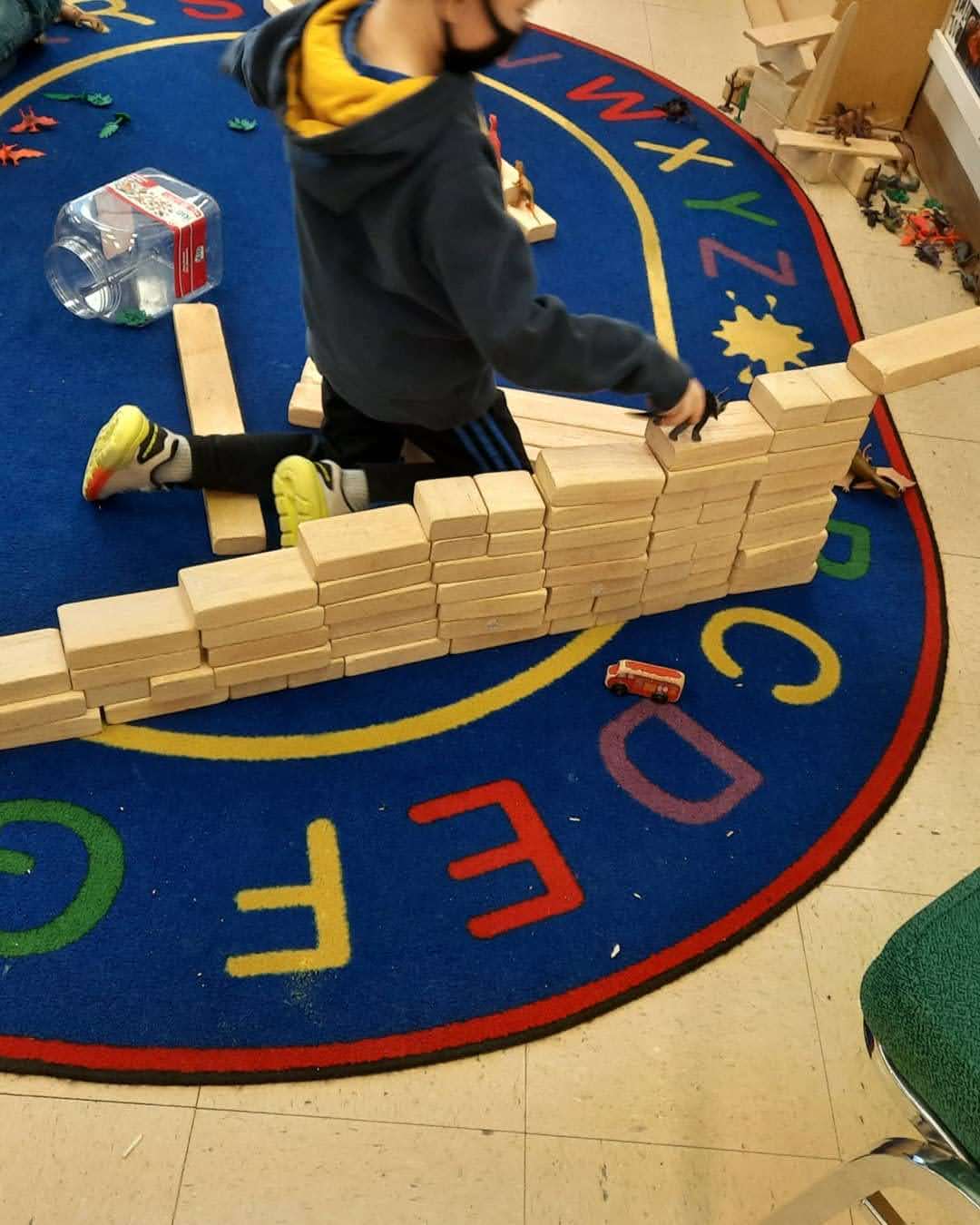
Before our winter break I noticed that some of us were interested in dinosaurs, so over the holidays I went out and bought some toy dinosaurs and set them out, along with some books I have. I didn't want to dictate what we would do with them, I didn't want a "unit" or a "study", I just wanted to give them another dimension of dramatic play. What I noticed was this: the more we interacted with each other as dinosaurs, both carnivores and herbivores, the less our aggression came through in other aspects of the day. Giving my students a place to put that type of aggression helps them self-regulate their own feelings of powerlessness (because I believe that's why we start off by hitting in the first place- we feel powerless in a situation and the only thing we can do is lash out). It allows them to feel that power, it allows them to "fight it out" in a safe environment. The more they have been able to use these dinosaurs, the less aggressive their play has become as a whole, and the more complex their play has become- from sorting and stacking, to building structures for the dinosaurs to climb on. And the aggressive behaviour outside of this play also continues to decline. 

Does this demonstrate the power of play in our lives? It most certainly does! Play isn't just a break, it isn't something an adult can manipulate in order to get an outcome they want. Play is what a human mammal needs to make sense of the world around them. Play is what we need to develop certain neural pathways in our brains. It is through play that we put into reality what our brain knows. As the teacher I have certain responsibilities to my students and their parents, but I can't make them learn. I believe it is my job to set up the environment in such a way that through their play they are able to master the skills they will need in life. Every day my students amaze me with what they can do. It is never easy to quantify this, to use it for comments on a report card- but it is always exactly what they need in order to be where they are and move forward. 

This is the stuff that makes teaching kindergarten so important. This is the stuff that matters. 


Sunday, September 20, 2020

Looking Through Rose Coloured Glasses


Sir Ken Robinson gave the most popular TedTalk of all time, Do Schools Kill Creativity In it, he explains that, yes, schools do kill creativity. It's an amazing talk, one I whole heartedly endorse, one I refer to frequently. His talk was very thought provoking. We lost Sir Robinson this past summer due to cancer. 
Today, on my walk, I was listening (again) to Michelle Obama read her book Becoming. In chapter 4 she talks about her childhood, her neighborhood and her school. Her experiences growing up mirror mine in many ways- the gathering of family, playing in the neighborhood, walking to a school not far away from home. I don't know if it's the death of an educational figure, listening to the book, the end of my summer, or Covid19- chances are all of these are the culprit- but apparently this last full week of my summer break has me in a melancholy mood. I'm starting to sound like my great aunt and uncle, "Back in my day, schools were better. Music was better."

I was a child, I know, so my memory is perhaps not 100% accurate, and I know the 70s were not a perfect time. I know vast portions of our society did not have the advantages I did. I do not want to return to that time, per se, but I think back to schools, to my educational opportunities, and I can't help but think we've lost something along the way.

The 70s were a time of neighborhood schools, people knew who lived next door, kids could be out from sun up to sun down. I walked alone to the gas station on the corner to buy a bottle of pop and a candy bar for .50, or my friends and I would ride our bikes a few blocks in the other direction to the "Little Store" where we bought penny candy. There was a local park with swings, a sprinkler that went all summer long, metal slides and climber. It was nothing for me to walk the six blocks to it alone. We had freedoms that we took for granted. Younger generations will never know what the streetlight coming on means to us. The same goes for school.

When I was in the fourth grade, my classroom was in the area surrounding the library. It was called "the pod" and there was an open classroom concept. We had dividing walls between each class, but they were open to the library. As a student, I don't remember being distracted by what was going on in the other classes or the library. I don't remember it being too loud. But I do remember the freedom we felt to get up, move around, work in groups. We went from having individual desks to tables. Group work was the norm. It was like the kindergarten idea, only for older children. 

Speaking of kindergarten, it was a true child's garden. We played, we made crafts, we had a short rest time and snack time. It was a half day, play based classroom and the favored "centre" to play in was a wooden climber in the middle of the classroom. Yes, a wooden climber where we could climb up, do flips over, walk across the ladder. When we made choices where we would play, we chose a colored string- the color for the climbing center was black, btw. I still remember this almost 50 years later.

Three quarters of the way through 4th grade, my family moved and I started a new school. A different set-up than the open classroom concept, but definitely the same teaching attitude. I think it was when I was in the 5th grade (but it could have been the end of 4th) that we took part in a city-wide program called "Free to be- you and me" based on the Marlo Thomas album and television special (https://en.wikipedia.org/wiki/Free_to_Be..._You_and_Me). We all piled into school busses for a week (maybe two) of full on arts education, with a strong side over of old school feminism. Pretty sure that wouldn't go over very well in todays climate. It truly makes me sad to think of how good I had it growing up and comparing it to now. We can't go back in time, but do you think, in some ways, education can?

We are currently in "uncharted territory" (I hate that term, but it is fitting in the context of modern education in the time of Covid19). Some of us are teaching virtually, some are teaching face to face, some are in a hybrid model. Those of us teaching face to face are learning to balance what is best for the physical health of our students and their mental/developmental health. Because of, or in spite of this, we have a chance to reset the trajectory of education. I have my masters in 21st century learning. Most people automatically think "technology", and that is a part, but it is so much more than that. Technology
is more like a tool for 21st century learning, it is not the driving force of it. What it is, is encapsulated by what is known as the 4C's of 21 Century Learning:

Critical Thinking
Communication
Collaboration
Creativity

Whether we are teaching face to face or virtually, we can include all four of these into our lessons. Now is the time to step up and truly think about each of these in relation to our lessons. 

Are we teaching our students to think critically? This is hugely important right now- as too many of us seem to have lost that ability. We must teach students to sift through all of the information that is available to them. In this age of information, we are inundated with so much. Add to that the algorithms that Google and other search engines utilize, which narrows our search to "similar" links, and we find ourselves in an echo chamber. We need to teach students to critically think about what they have read, and figure out ways to find opposing voices. 

Are we teaching our students to communicate appropriately? Another lost art in this current age. The computer is just one way we can do this, but that is only one "language" of many (see https://reggioemilia2015.weebly.com/the-100-languages.html) In a conversation about children in this time, Carla Rinaldi also includes technology as one of the languages (https://youtu.be/EKqXLbBvR00). There is a common "meme" I have seen floating around social media: "Social Media has made too many of you comfortable disrespecting people and not getting punched in the mouth for it..."(https://images.app.goo.gl/B7bQimqLumsaQpTAA). While I don't advocate physical violence, the sentiment is true. We live in an age where people hide behind keyboards and say whatever comes into their minds, without consequence. We need to teach our students how to communicate, and that includes listening to others points of view, and with empathy. 

Are we giving our students time to collaborate? As educators, we present material to our students, but it is through collaboration with each other that it begins to make concrete sense to them. Even when working virtually, students can be given the freedom to discuss and explain, they can still collaborate. The toughest thing for many to do is to let go and trust the learning that happens between students. But that is where the meat and potatoes happens. We must be available to help correct any misgivings, but we also need to remember to step back and allow them to work that out for themselves.

Are we allowing for creativity in our students? Are we giving them time to create, musically, artistically, writing? We can't merely spout off "the facts" and expect a well rounded individual (sorry conservative friends, but education is more than the filling of a pail). We need the arts to help us make sense of the facts. And, as a side note, math, science, and art are inextricably linked.

We cannot go back to the 70s nor should we want to. But the 4 C's are the perfect vehicle to bring education into the 21st century. Teachers need the freedom to incorporate this into their lessons. Scripts are great in order to illustrate how a lesson could go, but if it doesn't come from the heart of the teacher, then they are merely going to be clanging gongs. And, who listens to a clanging gong?

I am too old to have children in school today, but someday I hope to have grandchildren in schools. I want for them, what I had. I want kindergarten to be a truly play based experience, I want their teachers to have the freedom to introduce them to things and ideas I cannot. I want them to be critical thinkers, because a critical thinker is a person who is free from the shackles of other peoples opinions, a critical thinker can sift through the bias  and get to the source. I want them to be able to communicate to others in a variety of ways, and in such a way as to communicate respectfully and with confidence. 

In order to teach for the future, perhaps there are things from the past we can utilize. We desperately need to figure out a way to teach in a way that does not kill creativity, but one that finds what each child needs and helps them to capitalize on that.

Call me idealistic, and tell me I have on rose colored glasses, but I think we can do this. We can be 21st Century teachers, and we can change the course of education for the better! We owe it to the next generation. 


Sunday, January 31, 2016

Sand Play and Scientists


I once read an article that captivated me. As I was reading it, all I could think of was the children in my classes over the years who play with sand. And I thought of all of the times we've had to defend the practice of play as well as playing in the sand throughout the years. This article, Riddles In The Sand was written in 1996. Maybe more research has been done on sand. Maybe scientists and physicists understand how sand works now, at least more than they did in 1996. But as I read it, I was reminded that children are scientists. Children are physicists. Children are engineers. Every day, across the world, children are involved in theorizing, in planning, in trying out theories, and in finding 'proof' for their discoveries.

I was captivated, am still captivated, by the article, by the medium of sand, and by the idea that children are scientists. That is the purpose of this blog post. I wanted to put pictures to the words. I wanted to give credence to children and their play. I wanted to show that just as physicists and engineers theorize and experiment with materials, the idea to experiment, to theorize, begins in childhood. It begins with play. 

Riddles in the Sand
Physicists completely understand a solitary grain of sand. Why, then, are they at a complete loss to explain a mere handful of the stuff? 


"That not even a physicist can explain why sand behaves the way it does seems astonishing. Sand is neither invisibly small nor impossibly distant; observing it requires neither particle accelerators nor orbiting telescopes. The interactions of grains of sand are entirely governed by the same Newtonian laws that describe the motion of a bouncing ball or the orbit of Earth about the sun. The odd behavior of a layer of sand bounced up and down on a tray should, in principle be entirely knowable and entirely predictable. Why, then, can't Behringer [the physicist mentioned in the article] simply take a bunch of equations describing the motion of all of the individual grains, put them in a very large computer, and wait--for years, if necessary--until it spits out a prediction?" (p 2/9)


"Because the language of physics does not contain a vocabulary for granularity, engineers must treat granular material as either a liquid or a solid. These approximations work most of the time, but occasionally they lead to disaster....when the grains come to rest against one another they form intricate, quasi-self-supporting structures. That is why adding more grains to the top of a silo often does not increase the pressure delivered to the bottom at all, but rather increases pressure outward agains the sides of the silo." (p 3/9)


"Engineers who design buildings and roads, on the other hand, assume that under stress the supporting (and granular) soil will behave like a deforming solid, much the way plastic does. Once again, this convenient approximation occasionally leads to disasters." (p. 3/9)


"...if engineers understood the physics of soil better, these disasters might have been avoided." (p. 3/9)


"If you really want to describe what sand is doing in any given situation, you have to know which modes are dominant and which sets of equations you'll need to employ.... (p. 7/9)


"You just have to recognize that not everything you do is going to shake loose major pieces of knowledge... But collectively, and on rare occasions, experiments will come along and make a significant impact. It's like looking at a distribution of avalanches- you have a lot of little ones and, every once in a while, a big one." (p. 9/9)

(*all notes are from the article Riddles in the Sand by Fred Guterl,  DiscoverMagazine.com November 01, 1996. http://discovermagazine.com/1996/nov/riddlesinthesand915 All pictures are mine)

Wednesday, January 13, 2016

Time: Two Hours of Play

The original post was dated Jan 13. It is now Jan 30 and here is an update:

Ever since we started playing for 1 1/2 to 2 hours a day, this is what I've noticed:

1- The play is deeper, more thought provoking
2- They play is less frantic- they know they have time. They know they will have a beginning, a middle and an end that will be satisfying for them.
3- They are quieter when they play
4- (with the exception of 3 or 4) They are choosing a wider variety of activities. They are choosing literacy games and math games. 
5- The art that is created has more depth. It isn't just markers on paper anymore, they have added other media (the art shelf has been stacked with a variety of materials, they are just now getting to them)
6- When it is time for direct instruction, the sit and listen longer
7- I have to do less direct instruction

Now, I know there are other benefits that I am not listing here, and I know some of these behaviours could be seen as where the students are developmentally, but from everything I have observed, there has been no negative consequences to the prolonged play time. Which, of course, does not surprise me. When I meet with a student or two in a small group or one on one, they are more focussed on what we are doing, because they have confidence that they will be able to get back to their other play without missing too much time. This has only been a positive experience for us all.


I did something crazy yesterday. I let my students play for two hours. It was the best two hours we've had in a long time, and guess what? We'll be doing that from now on. Two hours of uninterrupted play time every day. Two hours to theorize, experiment, build, problem solve, create, learn, teach.


It started with a phone call. One of my friends at our provincial department of education phoned just before our Christmas break wondering if I'd be interested in being a part of a small group of kindergarten teachers who are being tasked with finding a way to return kindergarten to being more child-centred. Our province touts its kindergarten program as being play based with integrated curriculum, but as time has passed it's becoming more and more like a subject based program: first we have literacy, then we have math, then we have writers workshop... etc. I know many kindergarten teachers are feeling this push, and we are finding it harder and harder to push back. That phone call got me thinking about my own practice in the classroom, and I realized that while I talk about trusting students, and letting them play, more and more lately I have not been putting what I preach into practice. That phone call was a wake up call for me as well.

Over our break, I had to ask myself some tough questions. If I say we need to trust students to manage their own learning, am I doing that? Sometimes. If I say children need time to play in order to work through their learning, am I allowing the proper amount of time to do that? Again, sometimes.

Because I could not answer a definite yes, I knew it was time to re-think my practice.
-What will I do while they play that long?
-What if someone comes in and asks what's going on?
-What if they come in and want to know why I'm doing what I'm doing?

Here's what happened:

While the children were playing I was able to sit with a group and play a rousing game of letter go-fish. One of those students needs extra work in letter recognition, and I was able to sit with him, in a stress free environment, and have some fun while working on the letters.


I have another student who comes in every single day stressed out because he is anxious about Writers Workshop. No matter how many times I tell him that I don't expect him to have everything perfect, that I will help him, he still stresses over it. He spent a long time with a buddy building "a car building" in the block area. Then he went to the art area because he wanted to make a picture for his mom. I asked him if his mom ever asked what he did during the day, and he said yes. I suggested that he draw a picture of his structure so he could show her what he did. He thought that was a good idea but wasn't sure how to do that. I was able to model how I would draw the picture, then he was able to take that risk and do it himself. Because we had this time, I suggested he write down at the bottom what it was, and I was able to talk him through that. No stress, no tears, no anxiety. It was a big breakthrough for this guy.
 

Then, another guy, who struggles with some fine motor issues, was watching us and he decided to draw a "crabby patty" he had made in the kitchen area.


All of this would have been impossible if we didn't have the time. If we only had a half an hour of free choice time. Because we had such an extended time to play, children were able to play in more than one area, were able to begin a task and complete it. They were able to spend their time talking out ideas and problem solve with their peers. 

After our play time, it was recess, then we had snack and our specialty class. When the students came back to class, we all sat down as a group and we talked about our big play time. I asked them if they enjoyed it (of course they did) and if they'd like to do that every day (of course they do). So I put up on the board a list of things we "have to do" every day, things we "should do" every day, and things we "want to do" every day. Then I put up a simple time schedule and we filled in the blanks. As a group we were able to see how we can still fit in everything we "have to do" and "should do" and even the things we "want to do" and still have a big play time. 


We still have Writers Workshop and Guided Reading and Math. We still have large group instruction, but we don't have to spend time teaching things we already know. I can introduce the concepts, then they have the opportunity to work on these in their own time and space (and if they don't 'chose' to do it on their own, there is still time to 'encourage' them while still allowing them lots of time to play). Those of us who might need a little extra help can get that now during our large block of play time. We can play games and even have some one on one time. So many times I feel like I don't get a chance to sit down and play with the kids, get to know them. 

I am constantly asking, what happens if we trust children? What happens if we truly value play, value it enough to allow our students to actually play? Because when we trust children, we give them the tools they need to become self-motivated, we give them the responsibility for their learning. We help them find the gift that already resides in them. Children are capable, but too often we take that away from them. Let's give it back.