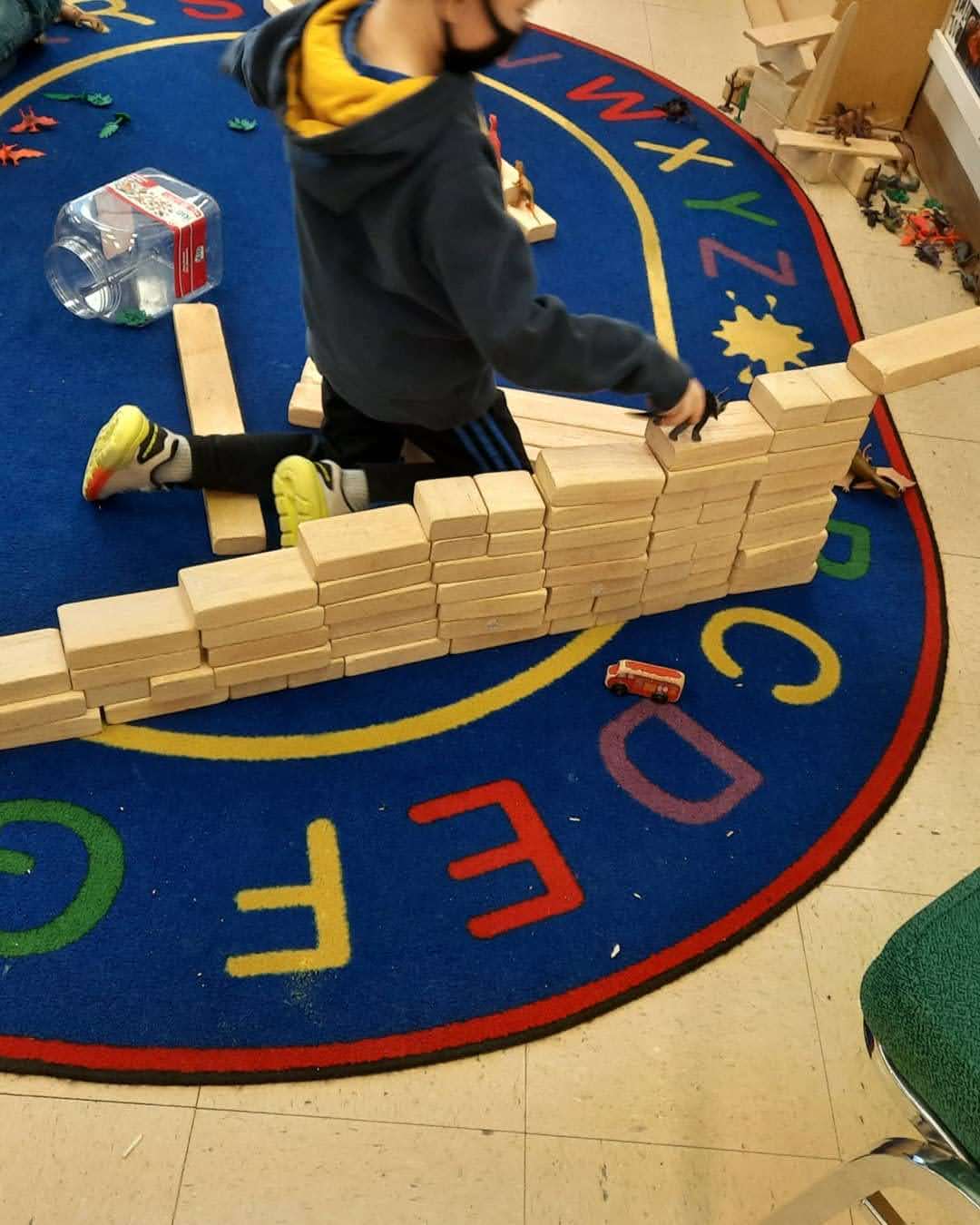
Scenes from my room: just put on some quiet jazz or nature music and you have the full picture
It's Saturday afternoon, and I am sitting in my classroom getting ready for the week ahead. You might think, Carrie! What are you doing? Why are you slaving away in your room when you could be at home relaxing??
What if I told you, I am relaxing? Workaholic tendencies aside, the environment my students and I have cultivated over the years in my classroom has made it one of the most relaxing, creativity inspiring places in my life. I am calm here, I can think here, my nervous system gets a reset here. I believe, I have passed this on to my students.
I've been sitting in on meetings these past few years. Meetings about kindergarten, meetings about play, meetings about instruction and practice. This past week, I was sitting in on yet another meeting which we were discussing all of this. We spoke about kindergarten and play based learning, and about setting up our environments, and this thought occurred to me: setting up my classroom environment is the single most important direct instruction I can do as a teacher. Teaching math concepts is good. Teaching literacy concepts is fine. But the single most important Teaching practice I can do is set up my classroom for learning.
I thought of all of the lessons I want to teach my students and it all came down to this:
Create a space that is joyful, welcoming, and calm. Provide quality materials for the students to explore, and let them play. Don't micro-manage, work together to create community, be an example. Give them the time, the space, the freedom, and the trust they need, and you will see them learn.
Those who know me, know I have a slight obsession with music documentaries. From 20 Feet from Stardom to Clive Davis: These Are The Songs Of Our Lives, to Echo in the Canyon. Today, I want to talk about Echo in the Canyon and what we can learn about 21st Century learning from 1960 rock music.
Echo is about Laurel Canyon and the community influence on the explosion of music in the 60s. At the beginning of the doc, Jakob Dylan (Bob Dylan's son and former Wallflower and successful artist in his own right) is interviewing some of the influential music makers of that time. All of them talk about how, everyone living so closely, all having like minds, sharing and collaborating, made for some of the best music. And not just the best music of the day, but music that has lasted over time. The Beach Boys, The Mama's and the Papa's, The Byrds, Buffalo Springfield, Jackson Browne, all of the individual artists that came out of these groups, and more. Even the Beatles were a part of it, and were heavily influenced by The Byrds and The Beach Boys.
Their legacy shows us this: Music is more than sounds, more than entertainment. Music teaches us, influences our thinking, and the process of creating music, good music, can't be reduced to a mere check list or data program. Good music is a product of communication, of collaboration, of creativity, and of critical thinking. All of the markers of 21 Century Learning.
Do we ever notice this in our classrooms? Do we notice how a group discussion can grow from a simple thought into a fully developed idea because more and more people add their thinking? Have you ever watched a group of students in pretend play build a whole world based on a simple box? It's the creativity and the creative flow that happens between 2 or more people that grow it and embellish it. While that can happen alone, but it becomes a fuller version when you add others' thoughts into the mix.
I think of students playing in the block area. One may begin building a simple structure, but soon another joins in and adds their idea. The structure becomes complex, more complex than if they were both playing alone. Once we add other children to the mix, we begin to discuss how we can make that bridge work, how tall can we grow that building without it falling over. We practice, we fail, we build again. We think about the laws of physics in a critical way, and before you know it, we understand the importance of all those teach us. We may not have the fancy words or explanations, but we have the experiences. And those experiences are the foundation for our learning- not just in blocks, but in many other areas. Vygotsky would call this "scaffolding". That, "learning occurs through purposeful, meaningful interactions with others."
All of these are interconnected, these ideas of critical thinking, of collaborating, of communicating, and creativity. While they can work in isolation, they are at their best when they are together. I think we need to realize this, and remember this. We can't teach them as subjects, they must be infused in all we do. Learning is a social endeavour, and humans are social beings. We cannot live, nor can we learn, in isolation. If we want society to be the best, the fullest, it can be, we must work together, and we must allow our students to work together. I know that in the age of Covid and social distancing this is difficult. But, wherever possible, we need to be thoughtful and creative ourselves and find ways to provide this type of environment.
I'm going to add a 5th C- one that is interspersed through all of the 4 C's: Community. When we put all of the 4 C's together, we get Community. and when one of the 4 C's breaks down, our community breaks down. What happened to the music of Laurel Canyon? What happens to everything eventually, there was a breakdown in the Community. We spend much time in Kindergarten creating community. Community is the heart of what we do, and without it, we cannot raise competent children.
I realize the "hot topic" in education at this very moment is face to face learning vs. online learning. Everyone agrees that face to face is best, but what if "face to face" means we are all sanctioned off in our own spaces, never touching another student? Can we do all of what we are talking about in that type of situation? I have seen that we can, but it isn't easy. Can we do this with virtual learning? I have seen what some have done, so yes, but, again, it isn't easy. But "hard" never stands in the way of quality teaching, and if there is anything we've learned over the last year, we can do hard things- we were meant to do hard things!
Some of the best music was written in community. People living and working together, sharing ideas, letting others influence them. How can we take this lesson and apply it to our lives and our classrooms today? Don't make the mistake that, because we must be apart, that we still can't be together. Building community is more than an idea today, it is a necessity. And the longer we have to deal with this pandemic, the more important it becomes.
This post is the third in a series around self-regulation. I started off by talking about the importance of long, uninterrupted play time in kindergarten that gets our minds and our bodies ready to sit and listen (for a developmentally appropriate amount of time, btw). Then I wrote on how the environment we create as adults (calm, serene, low-stress) adds to the way our students can self-regulate. Now I want to speak on a specific type of play- dramatic play. In this post I will be focusing on dinosaurs, because that's where we are in my class.
My observation is around dinosaurs and the type of play that is involved when we pretend we are large, carnivorous creatures. I hesitate to say "violent" because I don't think that's the attitude I want to cultivate in reading this. Perhaps aggressive is a better word; aggressive in a controlled way. I have a particular student (although he is not alone) whose first instinct when upset is to lash out and hit. All through September-December we worked on this, looking for ways we could react that didn't involve hurting others, and it was getting better. But, then we had two weeks off, and some behaviours returned.
Before our winter break I noticed that some of us were interested in dinosaurs, so over the holidays I went out and bought some toy dinosaurs and set them out, along with some books I have. I didn't want to dictate what we would do with them, I didn't want a "unit" or a "study", I just wanted to give them another dimension of dramatic play. What I noticed was this: the more we interacted with each other as dinosaurs, both carnivores and herbivores, the less our aggression came through in other aspects of the day. Giving my students a place to put that type of aggression helps them self-regulate their own feelings of powerlessness (because I believe that's why we start off by hitting in the first place- we feel powerless in a situation and the only thing we can do is lash out). It allows them to feel that power, it allows them to "fight it out" in a safe environment. The more they have been able to use these dinosaurs, the less aggressive their play has become as a whole, and the more complex their play has become- from sorting and stacking, to building structures for the dinosaurs to climb on. And the aggressive behaviour outside of this play also continues to decline.
Does this demonstrate the power of play in our lives? It most certainly does! Play isn't just a break, it isn't something an adult can manipulate in order to get an outcome they want. Play is what a human mammal needs to make sense of the world around them. Play is what we need to develop certain neural pathways in our brains. It is through play that we put into reality what our brain knows. As the teacher I have certain responsibilities to my students and their parents, but I can't make them learn. I believe it is my job to set up the environment in such a way that through their play they are able to master the skills they will need in life. Every day my students amaze me with what they can do. It is never easy to quantify this, to use it for comments on a report card- but it is always exactly what they need in order to be where they are and move forward.
This is the stuff that makes teaching kindergarten so important. This is the stuff that matters.
Authors Note: Last week I wrote about play and self-regulation. It seems I have a bit of a theme these days, because, in a sense, this week's post is also about self-regulation, and as I think about next weeks post... same thing! So, if you'd like to read last week's post, you can find it here: Play and Self-Regulation Now, on to this week:
In the course of a school year, particularly if you live in a northern climate, the months of January, February, and March drag on. Three months, but they can sometimes seem like the longest three months of the year. It's cold outside and the weather can be dreary and unpredictable. Every winter has its own pattern. This winter, our weather pattern seems to be: snow, rain, freeze, ice, snow, rain, freeze, ice, repeat.
In order to combat this type of seasonal unbalance, we try to make our inside calm. In our homes, this might manifest in comfy blankets and spaces, candle light, warm drinks, quiet music and sounds. We can do this in the classroom too. Embracing the Hygge way in the classroom leads to a sense of well-being for all, and another way to promote self-regulation in Kindergarten.
Because of Covid, our school has a "staggered entry"- which means, as the children get to school they come straight into the classroom. Other years they played on the playground until the school day began. This created students rushing to get into the school, pushing, shoving, chaos. When this year began, and we discussed this "new" idea, my concern was, what to do with them? I started out having play time. As soon as they came in, they would sign in (a way to practice writing their names), then they would go play- with the over-head fluorescent lights blazing away. As winter approached, this method wasn't really working for anyone- it was loud, it was hectic, and it was overwhelming for many. I thought about this and decided to switched our schedule around a bit- come in, sign in, and sit at the tables doing quiet activities like play dough, drawing, writing, reading, until everyone gets here, then do a morning meeting before our play time.
Now when the children come in, the lights are dimmed. I have a plethora of Christmas/fairy lights, as well as some stand up lamps around the room to give it a soft, warm glow. I play environmental music, or some kind of calming "happy" music. The children can talk, of course, they can move around and visit each other (masks on), it isn't an "everyone sit down and be quiet" time. It's just a calm, quiet way to centre ourselves before we start our day. So many of us ride the bus- which can be so hectic and crazy, then they come into a hallway where kids may be running up and down, yelling, etc (we are a hallway of 6 classrooms of 5 and 6 year olds after all)- that it helps to have this little down time to acclimate to being back in the classroom.
After we all arrive, we have a morning meeting. We sing songs, talk about the day, incorporate a little math workshop, then move into our play time. I keep the lights low for play time, as well, and I play the calming music in the background. We try to keep the atmosphere as cozy as possible. Sometimes I'll even put up a fireplace video or a video of a stream in winter, etc. on the board.
Does all of this work? It does. In the Reggio Emilia approach to learning, we often say "environment is the third teacher". This is a perfect example of that- if the environment is calm, it creates a general feeling of calm. And calmness allows us time to think, plan, create, problem solve, talk, and discuss. What I have found is even those days when we are a bit more...extra... than others, we still have room to breath. This idea of Hygge- creating a calming, cozy atmosphere- is possible in the Kindergarten classroom.
There are many things that Covid has taught us as educators. We were not trained to teach in a pandemic, we were not trained to teach students to wear masks and social distance as much as possible. But there have been some benefits of Covid- I call them my Covid Linings. Embracing a Hygge classroom is just one of those Covid Linings. I've toyed with it, I've experimented with it in the past, but this year has given me permission to just go with it. I think this will be the way from here on out.
Next Week: Self-Regulation part 3: Dinosaurs!
This website really helped me define what I mean by Hygge: Hygge House